
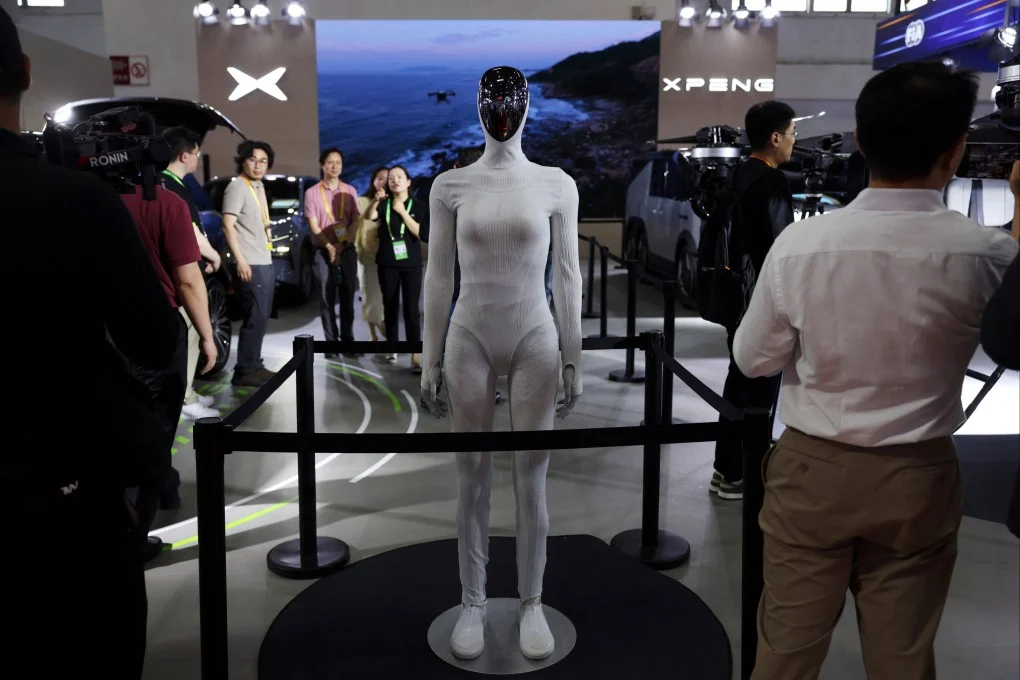
Chinese electric vehicle makers are increasingly expanding into humanoid robotics as slowing EV growth, intense competition, and weak profitability push companies to seek new sources of growth.
The shift follows a pattern seen across China’s technology sector. Automakers that invested heavily in electric vehicles over the past decade are now applying some of their technology, manufacturing capabilities, and supply chains to a new field that could eventually become a significant commercial market.
The timing is notable. China’s EV market is heading toward its weakest sales growth since 2021, while profitability across the industry remains under pressure. The average profit margin in China’s vehicle manufacturing sector was just 1.5% during the first half of 2026, according to industry data.
For automakers, humanoid robots offer more than a potential new revenue stream. They also provide an opportunity to strengthen their positioning as technology companies and create what analysts describe as a second growth curve.
Automakers seek new growth
Several major Chinese EV manufacturers have already entered the robotics sector, although their approaches vary.
Xpeng has been among the most aggressive. The company recently raised $900 million for its robotics business, valuing the unit at more than $6.3 billion. That valuation is close to the estimated value of Xpeng’s EV business, highlighting the importance investors and management are placing on robotics.
Xpeng plans to begin mass production of humanoid robots by the end of this year, initially deploying them in its own stores and business locations. The company intends to expand sales to the wider Chinese and international markets next year.
Other automakers, including BYD, Xiaomi, Li Auto, and Geely, are also exploring robotics. Nio’s venture investment arm has backed several humanoid robotics startups, while Xiaomi has begun testing humanoid robots at its factory.
The diversification comes as the traditional EV business becomes increasingly difficult. Price competition has intensified, growth is slowing, and manufacturers are facing pressure to protect margins.
For companies with established expertise in batteries, motors, chips, sensors, software, and automated manufacturing, robotics can appear to be a logical extension of their existing capabilities.
A potential advantage over Tesla
The strategy has similarities to Tesla’s development of its Optimus humanoid robot, but Chinese automakers may have some distinctive advantages.
Much of the technology used in modern electric vehicles can potentially be adapted for robots. Xpeng, for example, has indicated that a large portion of its motors, chips, and intelligent driving software could be reused in humanoid robots.
The manufacturing infrastructure is another potential advantage. Chinese automakers already operate large production networks capable of producing complex machines at scale. Applying those capabilities to robotics could allow companies to move more quickly from prototypes to commercial production.
There is also an important difference in how the robots can initially be used. Instead of waiting for households or businesses to purchase humanoids, automakers can deploy them directly in their own factories, stores, and other facilities.
That could create an early source of demand while giving companies opportunities to collect real-world operating data. For humanoid robotics, where software and artificial intelligence systems must continually improve through testing and deployment, that data could become an important competitive asset.
The commercialization challenge
The biggest question is whether demand will extend beyond the automakers themselves.
Deploying robots internally may demonstrate that the technology works, but it does not necessarily prove that customers are willing to pay for it at scale. Clear external orders and reliable forecasts for robotics revenue remain limited.
This is particularly important because humanoid robotics is still an emerging industry. Some companies have attracted substantial investor interest, but commercial adoption remains uncertain and could take years.
The challenge is not simply manufacturing the physical machines. Automakers must also adapt their artificial intelligence and software systems to environments that are considerably more complex than driving.
Vehicle systems are designed around a relatively structured operating environment. Humanoid robots must interact with people, objects, changing surroundings, and a much wider range of physical tasks. Developing software capable of handling those situations reliably could prove considerably more difficult.
A new growth curve, but not yet a proven market
For Chinese EV manufacturers, robotics offers a potentially attractive way to diversify beyond an increasingly competitive domestic car market. Existing expertise in manufacturing, electronics, software, and supply chains could lower some of the barriers faced by new entrants.
However, the investment case remains uncertain. Share prices have generally not responded enthusiastically to major robotics announcements, suggesting investors are still waiting for evidence that humanoids can generate meaningful commercial returns.
The sector therefore represents both an opportunity and a test. If Chinese automakers can successfully transfer their manufacturing capabilities and technology into robotics, they could establish themselves in another major technology market. If commercialization proves slower than expected, however, the investment could become another costly diversification effort.
For investors, the key indicators will be more than production targets or funding rounds. External customer orders, recurring robotics revenue, successful factory deployments, and evidence that the technology can operate reliably outside controlled environments will provide a clearer measure of whether humanoid robotics can become a genuine second growth engine for China’s EV industry.